
← Go back to Characters
Severe acute respiratory syndrome coronavirus 2 (SARS-CoV-2 for short) is a positive-sense single-stranded RNA (+ssRNA) respiratory virus, which belongs to the Coronaviridae family. It is the seventh coronavirus known to infect humans, and the third one known to be lethal.
History
SARS-CoV-2 was first discovered in Wuhan, Hubei, China, at the end of the year 2019. Since then, it quickly spread to other countries, and it caused a pandemic at the start of 2020. The virus started as a notifiable infectious disease, but it became less lethal to most people over time and officially became endemic worldwide by the year 2023, which also marked the end of the pandemic all together.
Disease And Symptoms
SARS-CoV-2's disease is known as Coronavirus Disease 2019, which is shortened to COVID-19. Its symptoms are very similar to a cold or influenza, but COVID-19 also causes symptoms which are rather uncommon in most other respiratory diseases. Its most well-known symptom is the loss of sense of smell (anosmia) and taste (ageusia). Other symptoms are; cold symptoms (such as a nasal cold, runny nose, sneezing, sore throat), coughing, shortness of breath, elevated temperature or fever, tiredness, (severe)headache, muscle aches, dizziness, irritability/confusion, abdominal pain, weight loss / loss of appetite, diarrhia, vomiting/nausea, eye pain, eye infection (conjunctivitis), skin abnormalities (such as a rash) and generally feeling unwell.
More severe to lethal symptoms are hypoxia, pneumonia, blood clots and organ failure, however this is relatively rare, yet many people need to be hospitalized nonetheless. People who are most at risk to fall severely ill, are the elderly and people who already have a weakened immune system. Spreading of COVID-19 to these people can be prevented by keeping distance (or just rather not visiting them at all while being infected!), wearing a mask or vaccination when working at nursing facilities.
Appearance

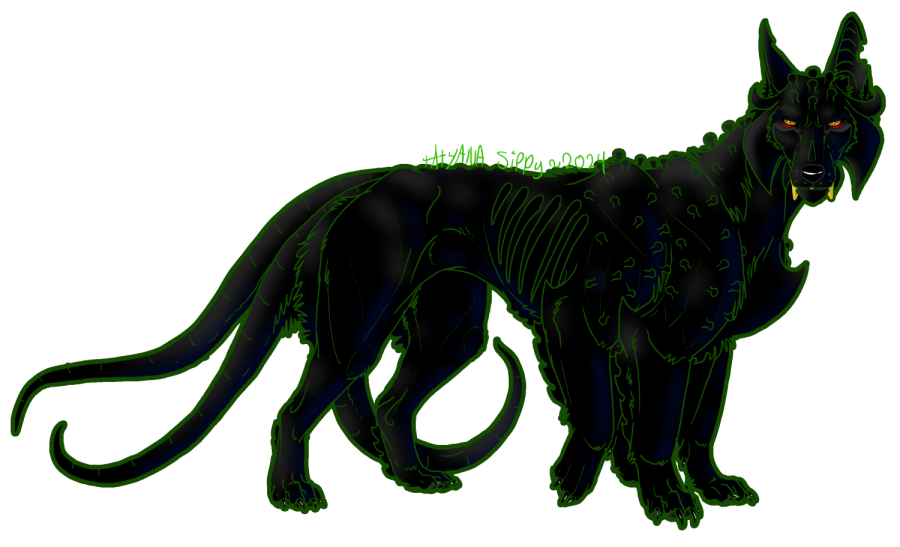
It sports four typical coronavirus hallmarks; it resembles a modern day carnivorous mammal, it has six legs, three tails and monarch virions have a crown of protein spikes (peplomers) on their head. Being a member of the Sarbecovirus (SARS-like coronaviruses) subgenus, it more specifically resembles a canid. SARS-CoV-2 has two forms too, which are the original wild-type Wuhan-Hu-1 (see wolf on above image) and both the EUR.B.1 variant and the D614G mutant (see the smaller dog on above image). SARS-CoV-2, like all viruses, is an all male species. It has a general monstrous look to it, a dark to all black color which comes handy when hiding in the darkness, slit pupils and sharp, strongly yellowed teeth. In many virions, the upper (and sometimes also lower) canines are really long and are still visible when the mouth is closed.

There are three types of virions within a nest, and these are easily recognizable by how their peplomers are aranged. The monarch-type virion has a crown on his head and the peplomers on his neck and shoulders are scattered. The scattered peplomers are based on a royal cape. The armored virion has his head peplomers set in a line, that goes all the way down to between his second pair of shoulders. The peplomers are also set in straight lines on his shoulders and all the way down to his upper arms. this is based on the crest/brush on a helmet and the armor on the suit of a medieval-time knight. The jester lacks head peplomers all together, but the peplomers on his neck and shoulders are either set in a straight line or scattered. This depends on from which litter he originates. The king is usually the largest virion, though smaller kings do exist too.
Peplomers come in different shapes and lengths too. The classic pinhead peplomer and the needle peplomer are the two most common. The tulip and pyramid are slightly less common, and the dragon horn and Shrek's ear are rare. The stalks of the peplomers can also be of the standard length, long or really short. Peplomers function as scent glands, and because they're rough to the touch, virions damage the host's tissue when rubbing their peplomers to mark their territory.

Dimensions
SARS-CoV-2 virions differe in size, but most notably do the two different forms. Wuhan-Hu-1 virions usually measure around 120 to 140 nanometer at the withers, while the EUR.B.1 variant and D614G mutant measure around 100 to 120 nanometer at the withers. EUR.B.1 can grow a bit larger even, but not as large as Wuhan-Hu-1. Weight is unknown, but the larger and bulkier virions are assumed to be definitely heavier than smaller and more lithe build virions. Pups are usually around 50 nanometer at birth, but, just like animals, the size differs between pups of the same litter. The virus can also have runts in its litters.
Proteins
The virus basically shares most of the same proteins as other coronaviruses, except for hemagglutinin-esterase, which only members of the Embecovirus subgenus possess. Its four most noteable proteins are its spike glycoprotein (teeth, claws and tongue), nucleocapsid (inards), membrane protein (fur) and envelope protein (tails). The spike glycoprotein S2 teeth and claws are used for the binding to cells, while the S1 tongue part is specifically used to infect. That is, if the receptor binding domain (a retractable hook) and RNA pores are activated. Otherwise, the tongue functions as a stabbing weapon when tensed and stretched out, but with the rbc and RNA pores not activated.
The nucleocapsid looks like a green colored pearl necklace and it is tightly packed inside a virion's body. It contains his RNA. A part of this protein can be found in the tongue, where it forms the RNA ducts that end in the pores on the activated tongue. When infecting a cell, a bit of the nucleocapsid is turned into a high in RNA concentrated fluid which leaks from the pores. The virion needs to rest in order to regenerate the lost bits of nucleocapsid, because a virion may die when infecting too many cells and not giving his nucleocapsid time to regenerate. However, this most likely never happens because they follow their instinct to take some rest after having infected a certain number of cells. And most virions only infect one to three cells at a time, anyway.
When a virion is wounded and his nucleocapsid is exposed, he's doomed to die for sure. Though, it differs in how fast a virions dies from his injury, mainly depending on how much is exposed and how good the general health and physical strength of the virion is. Virions may survive if they're lucky being found by a tribe of a probiotic bacterium and treated by their healer (the healer is obligated to help any microbe in medical need due to a golden rule in the 'Healer's Oath').
The envelope proteins mainly function as a balancing organ and in the virus's body language, but it can also be used as a stir when under water, to hold down enemies, as a deadly whip or to strangle enemies with. Though, only virions with really long tails can actually do this. Some virions also have prehensile envelope proteins and thus are able to grab onto or carry things with it. During embryonal development, this protein first appears as one single tail, but splits into three individual tails at some point. So, all three tails originate from the same root bone. The protein can eappear either as a normal looking dog or wolf tail, a somewhat longer tail or a really long tail (dragging on the floor like a cape when carried down). Every tail type is segmented though, but this is best visible on tails with minimal hair. Some virions have thick, bushy envelope proteins, so segmentation is less visible. Jester virions lack envelope proteins entirely due to a defective mutation. Some can walk normally, but due to the lack of this protein, jesters are physically the weakest, which indicates that the envelope protein is essential regarding a virion's health and functioning.
The membrane proteins are similar in appearance as dog/wolf hair and serve the same functions; protection and isolation. Wuhan-Hu-1 only has one type of coat, which exists of a layer of soft, wool-like hairs and a layer of longer and more coarse guard hairs covering the wooly layer. EUR.B.1 and D614G may come in more different types of coats; short, smooth (a softer and satin-like variety of short), long, silky (a softer, wavier and satin-like variety of long), wired, curly and double (the same type as seen in Wuhan-Hu-1). The double coat may in turn also come in either short, standard or long form. The membrane protein is naturally covered in special oils which makes it water resistant. Even though the protein technically does get wet, it successfully keeps water away from a virion's skin. The oils also cause the protein to form spikes which makes it easier for the water to leave the proteins so it can dry faster. But, this takes longer in longer haired virions, obviously. Virions shed their membrane proteins too, and, just like dogs, the severity of the shedding depends on the type of coat. SARS-CoV-2 also goes through shedding seasons, which is usually during early spring (shedding winter coat) and early fall (shedding summer coat). The thicker winter coat is specially noteable in double coated virions. Pups who haven't been through their first shedding yet, need the help of others to keep them warm or to dry them when getting wet, because the puppy coat isn't able to protect or isolate as good as the adult coat. Membrane proteins may come in the same colors and color combinations as wolves and dogs, though most virions are born all black due to adaptive melanism.
Other proteins are ORF's and NSP's, and these all form the other body parts, such as bones, muscles, whiskers, cartilage etc. The most noticeable of these are NSP5 (the heart), NSP9 (blood), NSP10 and NSP16 (brain) NSP14 (nervous system) and NSP15 (lungs). The virus's heart is literally cartoon heart-shaped (and I kid you not, it does so in the real world too!). Because it is so tiny, the virus has an extremely fast heart rate. The blood is a type of oil and green colored. The brain is similar in shape to that of dogs. The virus has the largest brain of any coronavirus, though the D614G mutant's brain is even slightly larger than that of both Wuhan-Hu-1 and EUR.B.1. NSP14 is also known as exoN and, besides being the virus's nervous system, it also has the ability to proofread, which boosts fidelity in its replication and recognizing nucleotide analogs (antivirals). The lungs are strong and relatively large, making the virus able to hold its breath for a long time.
Senses
SARS-CoV-2 has a sensitive sense of smell and hearing, but it has poor eyesight. All virions are born nearsighted, so everything appears blurry to them from a certain far distance. The virus is also a dichromat (having only two cones in the eyes), meaning that they see less colors than humans, which are trichomats (three cones). Like dogs, and most other carnivorous mammals, SARS-CoV-2 can only see blue and yellow, while red, green and purple/violet appear as either blue or a grayish yellow to it. The pupils shine in the darkness when a bit of light shines on the eyes. This is because a part on the inside of the eye is covered in specialized proteins that cause a reflecting effect, similar to cells that form the tapetum lucidum in the eyes of most animals. Like the tapetum cells in animals, these proteins help a virion see well in the dark. SARS-CoV-2 also has a transparent nictating membrane which it uses as diving goggles when under water. The eyes come in the colors yellow, red, green, amber, brown, teal and blue, or a different shade of mentioned colors. Yellow and red are the most common eye colors, while blue is the most rare color. Some virions may have heterochromia in one or both eyes, causing them to have two different colors in the same eye or two completely different colored eyes.
The virus's sense of smell is similar to that of dogs, and virions can smell scents from microns away. Even the oldest or faintest of scents can still be detected by virions with the strongest nose. Together with the vomeronasal organ (Jacobson's organ), a virion can smell even better, as well as differentiate between compounds and picking up pheromones in scents. Glycans (saliva) creep up and spread on the nose via the philtrum, the slit on the upper lip, which extends all the way up to the nose and ends between the nostrils, keeping the nose oily and healthy.
The ears are either wolflike (Wuhan-Hu-1) or doglike (EUR.B.1 and D614G mutant). Though, both the EUR.B.1 variant and D614G mutant can have more varying shapes of ears. The virus's hearing range is 65-45,000 Hz, so it hears much lower and higher-pitched tones than humans.
Health And Mutations
Because of its many mutations, SARS-CoV-2 is actually quite susceptible to health issues, both physical and mental, and the D614G mutant even more so in particular. Many virions are either born with congenital problems or they develop something later in live. Cancer and diseases of the brain, lungs and heart occur in the virus. Because its RdRp protein (bones) mutate the most, many virions are born with skeletal deformities, either unnoticable, mildly visible or severe. Necrosis can occur too, but in this case it's decay of damaged proteins.
The virus can't really get sick with infectious diseases, given it itself can't get infected by anything else. However, there are other things that may cause an illness or death in virions, such as the cytokines of some immune cells, stomach acid, soap, desinfectants and virucides. When bitten by a specialized virus fighting immune cell, cytokines cause detoriating neurological issues, with the virion eventually dying from a seizure some hours later. Soap, disinfectants and virucides kill virions. Though, there was once a virion who survived an injury caused by a small droplet of disinfectant. Stomach acid, when swallowed, burns the nucleocapsid, while both the smoke and gases forming cause the virion's belly to swell up and eventually explode if he doesn't get a neutralizing antidote in time. but, again, the virion then must be lucky to come accross the tribe of a probiotic bacterium, and the healer must happen to have said antidote in stock. Otherwise, he's still doomed to die.
Cancer in viruses is similar to human cancer, though in viruses it's malicious proteins forming and clumping together to form tumors. Viruses always die of the disease, because there's no cure for it. Cancer is relatively rare nonetheless. There's a type of epilepsy present in the D614G mutant, which seems to be genetic. Seizures mainly seem to occur when the affected virion has intense emotions, like anger for example. Some virions may have heart conditions, though it's mostly the older virions who seem to develop these heart conditions, heart attacks or cardiac arrest. Many virions have cognitive disorders or mental disorders as well, such as stuttering, autism, schizophrenia, schizoaffective disorder, narcissistic personality disorder, bipolar, borderline personality disorder etc. Though it occurs much more strongly in it, mental disorders aren't exclusive to the D614G mutant, as there was once a EUR.B.1 virion who had a personality disorder combined with grandiose delusions.
SARS-CoV-2 can actually get ecto-parasites, though said parasites won't stay for too long because the virus can't give them what they need. These parasites are known as viroids, which are very tiny, non-sentient viruses that are mostly made of RNA or DNA and only a few proteins, and usually live in plants. Humans eat plants, so a viroid may come along and try to infect the resident cells and other microbes. To cells, viruses and bacteria, the bites of these rather harmless viroids are merely itchy, so they're basically like fleas to the larger microbes. The viroids will desperately trying to infect the ones they latch on to, though viroids can't survive for long in the human body, nor on the resident microbes, so the viroid infestation won't spread further and the ones unfortunate enough to come accross them won't be suffering from that annoying itch for too long.
D614G Mutation
SARS-CoV-2 has many, MANY mutations. Too many to talk about here actually, but D614G is the most noteable one, so it will be described here. This mutation is a change from aspartic acid (D) to glycine (G) on the spike glyco protein and it is present in all variants born after EUR.B.1. This mutation caused the virus to be better adapted to the human body, being easier transmitted from host to host and become more virulent. It also caused the virus to become somewhat more intelligent, develop more emotions and feelings, grow attached to pack members and just become more social in behavior in general. The D614G mutant also displays parental care and development of strong father-son bonds with their pups, something never seen before in other coronaviruses, let alone Wuhan-Hu-1 and EUR.B.1. It can also use telepathy, which may be a side-effect of its higher intelligence. D614G mutant virions are always born with a kind heart and will retain their kindness even into adulthood, unless they get corrupted by someone during chilhood. Because it has developed more feelings, a virion may also become rather vengeful when he's deeply hurt by someone or hateful once he learns that others aren't as he thought they were.
Behavior
Text
Related Species
Text